What a Christmas Music Lesson Says About Curriculum
21 December 2022

We’d like to thank Alex Parsons from Bullers Wood Girls School for allowing us to share his blog post. You can view the original on Alex’s blog Treble Teaching
The lesson before Christmas
As the first school term comes to an end there emerges the annual debate of what to do in the last lesson. You will hear opinions on one side opining that teachers are on their knees, attendance is generally dreadful and that there are often many disruptions to the last week, therefore what is the harm with whacking on a film. Others decry that education is sacrosanct and nothing should interfere with valuable teaching and learning time.
For music teachers there is often another layer to this that we must deal with. While some colleagues may appear to be winding down for the holiday break, we are often at the apex of our academic year. Carol services, concerts, winter showcases, talent shows, musicals, assemblies and outreach programmes saturate December with rewarding but tiring work.
I have tended to take a measured and pragmatic approach when it comes to lessons in the final few days of term. If there has been something important to teach I teach it. If for any of the reasons listed above I cannot, I have, in the past, put a film on. I would be lying if I said I hadn’t. Sometimes the night after a show, having got into bed at midnight, I simply could not face enthusiastically jumping around the room, agogo in hand, shouting C major, 2, 3, 4!
Although, recently something in my approach has changed. To explain why I want to recount my YR8 lesson from the last day of term. There are typically no lessons on the last day before the Christmas break at my school. We have a mixture of enrichment (a whole-school talent show), year assemblies and form time. However, this year we had one period with our classes. I elected to spend this valuable time with my YR8 class making music. We all played ‘Last Christmas’ by Wham together as a class band! And, I gleaned something about our KS3 curriculum that may change the way I approach these one-off lessons forevermore.
The lesson
The resources through which I taught this lesson can be found at Musical Futures Online. Its an online platform providing resources which enable teachers to facilitate whole-class instrumental teaching on a variety of different instruments. The website requires an annual subscription. Believe me, I know budgets are tight but in my opinion it is worth every penny. They have some free/trial resources available on their website, of which Last Christmas is one
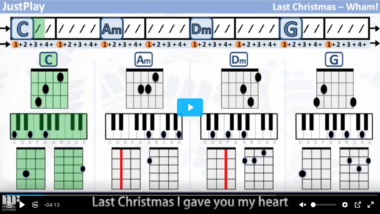

I won’t go into the detail of the teaching but below is a brief summary of what the 50 minute lesson looked it.
- Singing warm up (I like a good old 1, 121, 12321 etc.)
- Sing through the song as a class (once with the vocals, once without)
- Chair drumming of the song – this gives students a chance to internalise the song further, as well as practise their kit playing
- Students pick a harmony instrument; keyboard, ukulele or guitar and rehearse the four chord pattern
- One last rehearsal where students pick any or the above; vocals, kit, keyboard, ukulele, guitar
- Whole-class performance of Last Christmas
What this lesson says about our curriculum
At the outset I was less concerned with students making mountains of progress and simply wanted them to experience music making in their last lesson. However, I was taken aback at the amount of students who were able to achieve excellent outcomes in just a single lesson with new material. Most students played an 1/8th note backbeat in time with backing track at 108BPM. The vast majority were also able to play the four chord pattern of C Am Dm G in a quaver pattern in time and changing fluently between chords on an instrument of their choice.
After the lesson I contemplated how my YR8 class, containing students who had only experienced 42 hours of secondary school music, were able to play this new material accurately and musically. I believe it’s down to this single lesson being a microcosm of our KS3 curriculum. It utterly reflects the values of how we teach and learn music in our school. The skills that students needed to access this new song had been practised many times previously.
- Sing more or less in tune, following the contour of a melody
- Play basic beats on kit in time
- Read chord boxes and play on ukulele/guitar
- Play a simple part showing awareness of musicality
- Follow performance directions in the moment
- Form major/minor on the keyboard
- Play chords at the correct time, changing fluently
- Play bass + chords together, or sing + play at same time
In this lesson students were transferring knowledge about the above skills into a different context.
Our curriculum
How did our curriculum get us to this place? A place where students can be produce a musical performance of a new song and in less than 50 minutes? I believe the answer lies in how our KS3 curriculum is constructed. Our curriculum centres around a progression framework of 27 skills [Table 1], of which all schemes of learning are built around. Every lesson we teach is informed by this list. It is by no means exhaustive and we often aim to teach beyond it, but it is a great starting point.

Reflections
I will be talking about my school’s KS3 music curriculum in more detail in the new year. However, this lesson helped me appreciate the success of our approach. It also allowed me to reflect on the fact that perhaps the actual material (genres/composer/pieces) students learn is secondary. It is only the vehicle through which you can help build better musicians. This approach could allow teachers to be more responsive to the changes in our art form. Teachers can choose to adapt lessons or schemes to reflect the interests of the students or introduce them to something completely new and allow help them to explored uncharted territory.
In this instance it allowed me to plan a lesson which fed into our academic calendar; it reflected our end of term celebrations but also afforded students the chance to practise and consolidate the skills on our progression framework. What I came to realise was as long as students are doing this they are making progress and becoming better musicians.
Music gets such little time in KS3 curriculum, surely every lesson should be maximised. I only get to see each KS3 class 6/7 times a half term. If this lesson is not used to make students better musicians, that is 14-16% of an opportunity missed.
Alex Parsons – Head of Music, Bullers Wood Girls School – Kent
More from the Blog
Read other recent updates from the team at Musical Futures Online


